
How I Am Mother questions the impact of human nature and ethics to display a dark, not-too-distant future
By John Lutz
In the words of Jeff Goldblum’s infamous Dr. Ian Malcolm from Jurassic Park, “scientists were so preoccupied with whether or not they could, they didn’t stop to think if they should.”
Of course, Malcolm was referencing dinosaurs, an anomaly that fascinates Americans even to this day that it’s hard to not understand the curiosity of the scientists. And it certainly would be crazy to fathom giant lizards roaming around America today, but it’s not incredibly hard to fathom walking, talking, and reasoning robots living and inhabiting humanity’s homes, stores, and restaurants. In fact, much of the technology of today supports extreme tech dependence, with self-driving cars and AI assistants like Siri and Alexa supporting the idea. Yet these groundbreaking inventions may only be the minuscule starting point for even deeper discovery.
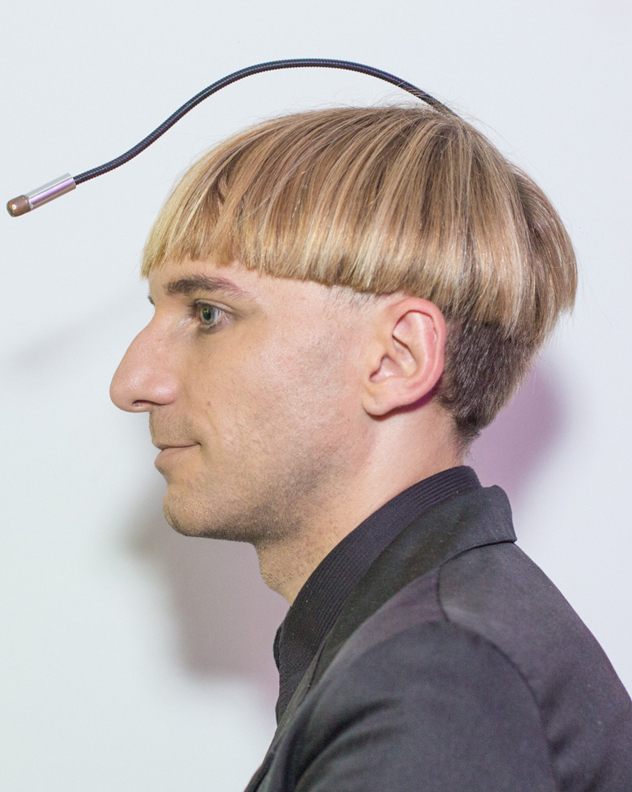
According to science historian Michael Bess of Vanderbilt University, lately humanity has been, so to speak, playing God. “Bioelectric implants, genetic modification packages, the ability to tamper with our very own biology – this stuff goes far beyond previous advances, and I’m not even sure we’ve even begun to understand the implications,” says Bess. One of the prime examples of Bess’s argument stands in Neil Harbisson, a real-life human cyborg.
Around 2007, Harbisson received an antenna implant in the back of his head, in addition to receiving a mechanical eye, or an “eyeborg.” These additions come as a result of Harbisson’s extreme colorblindness, or achromatopsia. The catch lies in the fact that these additions go far beyond their intended goal. “He [Harbisson] is capable of experiencing colors beyond the scope of normal human percpeption: Amy Winehouse is red and pink, while ringtones are green,” according to the Medical Futurist. But if this technology exists, why not go ahead and make a fully automated being that lives, breathes, and above all reasons just as humans do?
Director Grant Sputore presents the concept of an ethical cyborg in his feature film debut, I Am Mother. In the film, Rose Byrne provides the voice of Mother, a cyborg tasked with restarting the human race after immense decimation. She raises Daughter (Clara Rugaard) to be an ideal human being, vastly different from the humans that once populated the earth. Many of the lessons that Mother imposes on Daughter seem reasonable for a teenage girl, with dancing being one of the areas that Daughter actually seems to appreciate. Yet some of the educational lessons, specifically regarding ethics, appear far blurrier and much more questionable.
In a scene early on in the film, Mother presents a question to Daughter: You [Daughter] are a doctor, and are tasked with saving five patients facing death. These patients require organ transplants, and you have the organs to complete the transplant. Do you sacrifice your own organs to save them? This type of question has permeated ethical debate for decades, falling in line with other questions, such as “if you try to be an honest person at all times, do you tell an assassin where their target is hiding?” These questions often present a tough dilemma to those being questioned, and the interaction between Mother and Daughter is no different. Daughter becomes extremely hesitant in answering the question, and the discomfort comes across in both her performance and dialogue. Mother, however, appears very eager to offer a clear-cut solution, with the frankness of Byrne’s vocal performance offering credence to this openness.
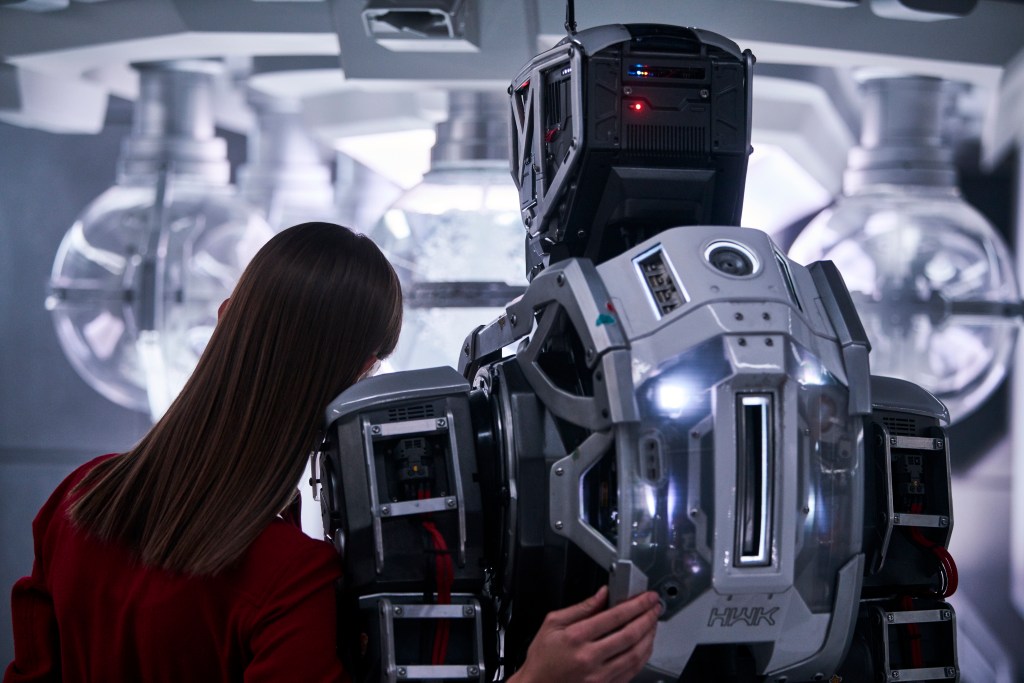
From the perspective of Mother, she likely would sacrifice herself in the situation. On the surface, this sounds extremely noble and just. However, the horror comes in the fact that Mother can come to this solution on her own. According to Donna Haraway, a cyborg, by definition, is “a cybernetic organism, a creature of social reality as well as a creature of fiction.” Mother exists as a fully automated being, with a hive mind consciousness that allows her to control other robots outside of her home compound. Yet, the living component of Mother comes in her ability to reason, essentially creating a utilitarian being with the mind of a human. This creates the horror of her character, in addition to the fact that Daughter initially has clear admiration for Mother.
Other situations arise throughout the film that call into question Mother’s state of being. For instance, Hilary Swank portrays Woman in the film, and although it’s never outright said, it’s clear that she is a former child who escaped Mother’s compound. At the end of the film, Mother murders Woman, stating she has fulfilled her purpose of spurring along Daughter. This just shows the enormity of Mother’s logic and reasoning, furthering the question of Mother’s sentience. According to director Alex Garland, “you’d have to start giving [sentient machines] human rights” when they can do these kinds of things.
Yet as much as Mother portrays the villain role in I Am Mother, the primary question should be who created this monstrosity? In other films where technology grabs a hold of human life, such as Her and Ex Machina, can the finger really be pointed at the machine? After all, it had to have been a human that programmed these directives and invented the machine. Did we create our own worst nightmares?
 John's Blog