How Yorgos Lanthimos’s The Lobster provides a juxtaposed relationship-obsessed culture that is just as frightening as the real thing
By John Lutz
Users of apps like Tinder, Bumble, and Hinge today don’t need to worry about turning into an animal at the sake of not finding a match. But they likely can relate closely to the fears of those who will inevitably turn into lobsters, dogs, or parrots.
Yorgos Lanthimos imagines this kind of dark and comical reality in his 2015 feature film, The Lobster. The film tells the story of David (Colin Farrell), a recently single man who journeys to an infamous hotel to forge a new relationship. David has 45 days to kindle this new bond, or he will be turned into a lobster (the animal of his personal choice). In the film, Lanthimos and screenwriter Efthimis Filippou reimagine the 21st century’s “hook-up culture,” with results and realities just as terrifying as the world the current generation faces.
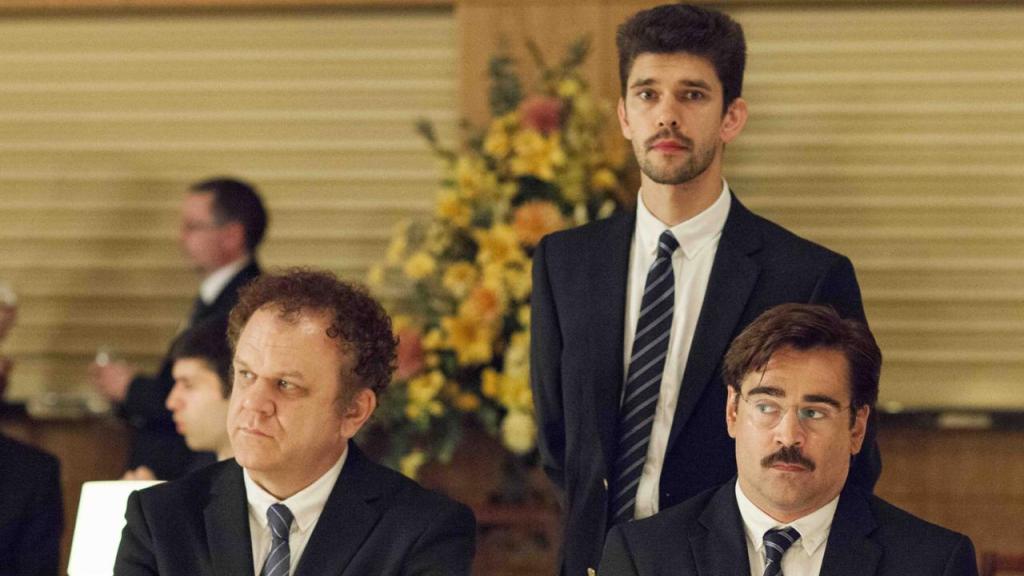
David (Colin Farrell) and his newfound companions, the Limping Man (Ben Whishaw) and the Lisping Man (John C. Reilly) find themselves at one of the Hotel’s infamous dinner parties. (Image courtesy of A24)
Hookup culture, as defined by Justin R. Garcia, refers to “uncommitted sexual encounters.” Apps such as Tinder and Bumble have become infamous for this kind of behavior, with Tinder specifically being known for its provocative nature. While users of these apps can expect a great deal more from their potential matches, such as a blossoming conjugal relationship, many use the service for one night stands and other limited encounters. Tinder, developed in 2012 by Sean Rad and Justin Manteen, was made to revolutionize the dating world, but in a very nontraditional sense. In an interview with TIME Magazine, Rad stated that he and co-founder Manteen “always saw the interface of Tinder as a game.” This addictive nature is certainly still felt by many in 2020, and the guests at the hotel in Lanthimos’s The Lobster felt this intensity as well, but in a different way.
In The Lobster, the hotel serves as the “Tinder interface,” where guests are driven by the concierges and workers to foster potential matches. The necessity of developing a relationship with someone in the hotel roots itself mostly from fear. Demonstrations, given by the hotel manager (Olivia Colman), ground the relationships out of fear and necessity. For instance, a woman shouldn’t walk alone, for she could be shot. When she walks with a man, she is guaranteed protection. These demonstrations, as well as the hotel’s sponsored dances and dinners, lead to lots of awkwardness amongst the guests. But the hotel isn’t responsible for fake behavior that correlates exactly with Tinder. Rather, the guests are responsible for it themselves.
About halfway through the film, David forces a relationship with a truly heartless and nefarious woman (Angeliki Papoulia). As could be expected, the relationship goes awry when the woman becomes aware of David’s falsified behavior. Many women and men can relate to the woman, as she was essentially “catfished,” or led to falsely contribute to a relationship. It turns out that many users seeking online love follow David’s path, with Internet guru Norton going so far as to estimate that one out of ten dating profiles online exists as a fake. And while David merely escape punishment, users who are catfished may not move on unscathed, with lost money, ambitions, and tragedy often at the other end of their path.
One of the most ironic elements of Lanthimos’s The Lobster results from how David ends up falling in love without force or oppression. He didn’t fall in love with any women present at the lifeless dances or bleak demonstrations; rather, he falls into love with the Shortsighted Woman (Rachel Weisz), one of the loners in the woods. The two revel in their rebelliousness to their respective factions, and as a result forge a real bond created out of love. Much like the hotel, apps such as Tinder lose sight of their end goal by their game-like nature. Why settle down when an even more attractive or successful match lies within one or two swipes? Lanthimos suggests that by putting down the phone or leaving preconceived notions about love and romanticism behind, a true relationship can form and blossom.
Tinder offers a variety of services, such as a premium service (Tinder Gold) and ‘superlikes’ to engage users. (Image courtesy of Tinder & TechCrunch)
Yet apps aside from Tinder, such as Bumble, posit how relationships can develop outside of love or necessity for physical attraction. Over the last few years Bumble has added to its initial concept by allowing users to create matches for a new best friend or business purposes. These kinds of moves distinguish Bumble from its predecessor of Tinder, allowing users to implement the app to meet their needs. This only begs the question: what would similar hotels look like in The Lobster if they were set up for business purposes or friendships? Would the rules still be as strict, ideologies still so confined to their respective subject matter?
By thinking outside the box, Bumble has opened the floodgates even wider than Tinder did for online dating initially eight years ago. Similarly, Lanthimos has opened the satirical door wide open with regards to relationships in this technologically-advancing age. The incessant need for companionship can be completely lost when one’s nose finds itself buried in 5.5 inches of blue light day in and day out.
How I Am Mother questions the impact of human nature and ethics to display a dark, not-too-distant future
By John Lutz
In the words of Jeff Goldblum’s infamous Dr. Ian Malcolm from Jurassic Park, “scientists were so preoccupied with whether or not they could, they didn’t stop to think if they should.”
Of course, Malcolm was referencing dinosaurs, an anomaly that fascinates Americans even to this day that it’s hard to not understand the curiosity of the scientists. And it certainly would be crazy to fathom giant lizards roaming around America today, but it’s not incredibly hard to fathom walking, talking, and reasoning robots living and inhabiting humanity’s homes, stores, and restaurants. In fact, much of the technology of today supports extreme tech dependence, with self-driving cars and AI assistants like Siri and Alexa supporting the idea. Yet these groundbreaking inventions may only be the minuscule starting point for even deeper discovery.
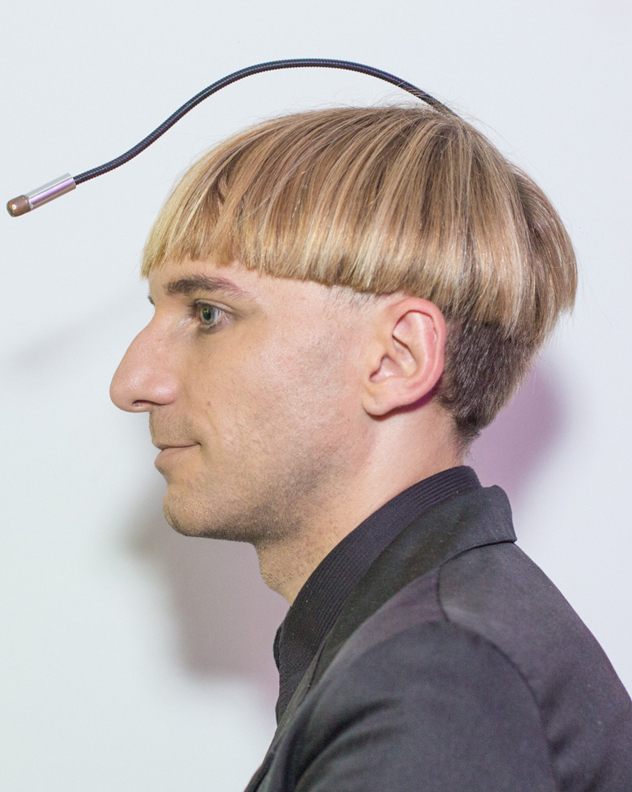
According to science historian Michael Bess of Vanderbilt University, lately humanity has been, so to speak, playing God. “Bioelectric implants, genetic modification packages, the ability to tamper with our very own biology – this stuff goes far beyond previous advances, and I’m not even sure we’ve even begun to understand the implications,” says Bess. One of the prime examples of Bess’s argument stands in Neil Harbisson, a real-life human cyborg.
Around 2007, Harbisson received an antenna implant in the back of his head, in addition to receiving a mechanical eye, or an “eyeborg.” These additions come as a result of Harbisson’s extreme colorblindness, or achromatopsia. The catch lies in the fact that these additions go far beyond their intended goal. “He [Harbisson] is capable of experiencing colors beyond the scope of normal human percpeption: Amy Winehouse is red and pink, while ringtones are green,” according to the Medical Futurist. But if this technology exists, why not go ahead and make a fully automated being that lives, breathes, and above all reasons just as humans do?
Harbisson is probably the world’s most well-known cyborg. (Image courtesy of Thinking Heads)
Director Grant Sputore presents the concept of an ethical cyborg in his feature film debut, I Am Mother. In the film, Rose Byrne provides the voice of Mother, a cyborg tasked with restarting the human race after immense decimation. She raises Daughter (Clara Rugaard) to be an ideal human being, vastly different from the humans that once populated the earth. Many of the lessons that Mother imposes on Daughter seem reasonable for a teenage girl, with dancing being one of the areas that Daughter actually seems to appreciate. Yet some of the educational lessons, specifically regarding ethics, appear far blurrier and much more questionable.
In a scene early on in the film, Mother presents a question to Daughter: You [Daughter] are a doctor, and are tasked with saving five patients facing death. These patients require organ transplants, and you have the organs to complete the transplant. Do you sacrifice your own organs to save them? This type of question has permeated ethical debate for decades, falling in line with other questions, such as “if you try to be an honest person at all times, do you tell an assassin where their target is hiding?” These questions often present a tough dilemma to those being questioned, and the interaction between Mother and Daughter is no different. Daughter becomes extremely hesitant in answering the question, and the discomfort comes across in both her performance and dialogue. Mother, however, appears very eager to offer a clear-cut solution, with the frankness of Byrne’s vocal performance offering credence to this openness.
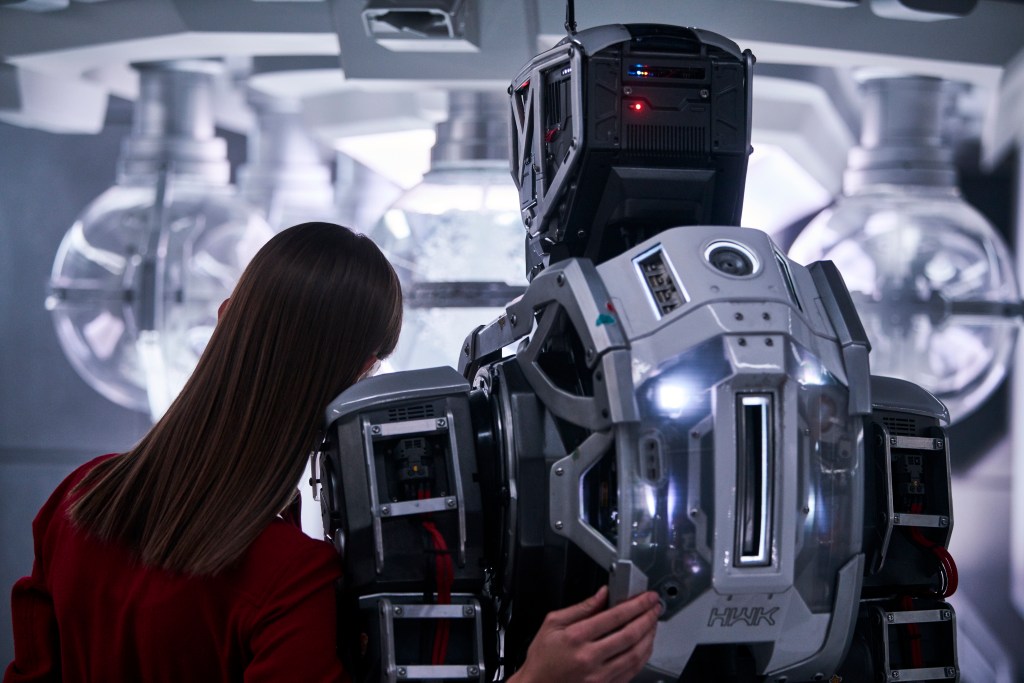
Mother and Daughter share a cruel and twisted relationship throughout much of the film. (Image courtesy of Netflix)
From the perspective of Mother, she likely would sacrifice herself in the situation. On the surface, this sounds extremely noble and just. However, the horror comes in the fact that Mother can come to this solution on her own. According to Donna Haraway, a cyborg, by definition, is “a cybernetic organism, a creature of social reality as well as a creature of fiction.” Mother exists as a fully automated being, with a hive mind consciousness that allows her to control other robots outside of her home compound. Yet, the living component of Mother comes in her ability to reason, essentially creating a utilitarian being with the mind of a human. This creates the horror of her character, in addition to the fact that Daughter initially has clear admiration for Mother.
Other situations arise throughout the film that call into question Mother’s state of being. For instance, Hilary Swank portrays Woman in the film, and although it’s never outright said, it’s clear that she is a former child who escaped Mother’s compound. At the end of the film, Mother murders Woman, stating she has fulfilled her purpose of spurring along Daughter. This just shows the enormity of Mother’s logic and reasoning, furthering the question of Mother’s sentience. According to director Alex Garland, “you’d have to start giving [sentient machines] human rights” when they can do these kinds of things.
Yet as much as Mother portrays the villain role in I Am Mother, the primary question should be who created this monstrosity? In other films where technology grabs a hold of human life, such as Her and Ex Machina, can the finger really be pointed at the machine? After all, it had to have been a human that programmed these directives and invented the machine. Did we create our own worst nightmares?
How films like Fight Club, American Beauty, Office Space, & The Stepford Wives represent the malaise of white men facing a new era onscreen
By John Lutz
It’s hard to imagine a character like Lester Burnham (Kevin Spacey) from American Beauty interacting with Tyler Durden (Brad Pitt) from Fight Club, but odds are that the two would likely have a lot to talk about.
The key lies in the release of these two films: 1999. It was at this point that a wave of confusion washed over countless white males onscreen, forcing them to consider life, existence, and happiness. While white men struggled to come to terms with these quandaries, women rose high in the ranks, achieving long-deserved equal status. Technology, too, gained much ground, as offices adorned their walls and hallways with printers, fax machines and computers. This did little to quell men’s feelings, and in the case of some, became the very bane of their existence.
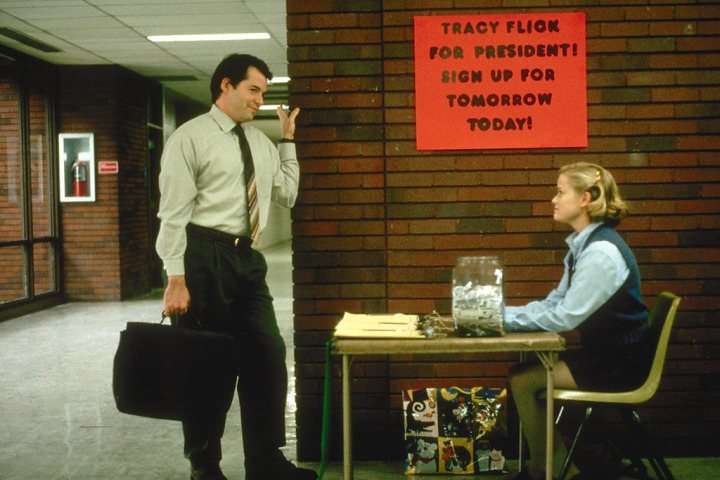
Perhaps one of the strongest examples of female empowerment writhing its way into the anger of many men lies in Alexander Payne’s film Election. Tracy Flick (Reese Witherspoon) proves to be the true thorn in the side of Jim McAllister (Matthew Broderick), a high school teacher and proctor of the school’s student election. As the film progresses, McAllister’s frustration evolves, progressing from mere annoyance to a skewed sexual frustration, eliciting many similarities to male characters in other films of the time. Lester from American Beauty immediately comes to mind, but even Edward Norton’s narrator in Fight Club becomes a mixture of frustration and arousal as Marla Singer (Helena Bonham Carter) wriggles her way into male-dominated support groups. But all of this confused animosity had to arise from some new force, one that white men in particular would not have the clear upper hand in grasping.
The animosity felt between the two can be understood in this one brief still. (Image courtesy of MTV Productions and Paramount
Technology certainly contributed to this newfound attitude. As many researches have pointed out, the fear of technology, technophobia, relates to the concept of losing control. And this idea can be seen throughout history, with many noting its origins in America with the Industrial Revolution. Films have also played with this concept, and perhaps one of the strongest examples connecting technophobia to men exists in both the 1975 and 2004 versions of The Stepford Wives. Both versions find men connecting their phobias of technology and losing control over women. These films see men seeking to control and fully dominate their wives, making them mindless robots who complete every task requested, from inane cleaning to “passionate” fornication. Yet it’s Frank Oz’s 2004 version that really connects technophobia with the loss of control. The men of this film aim to connect the two, taking strong women with incredible, formerly male-dominated careers (e.g. Joanna’s (Nicole Kidman) power as a television executive), and seeking to make them characterless androids. Joanna’s husband, Walter (Matthew Broderick), notes of this feeling of loss and anguish in a speech to his wife about his lack of purpose or necessity in their marriage. The current study of a gender bias in AI devices (e.g. Alexa and Siri) provides further relevance to this idea, all the while cementing it as an undeniable development of the 21st century white male.
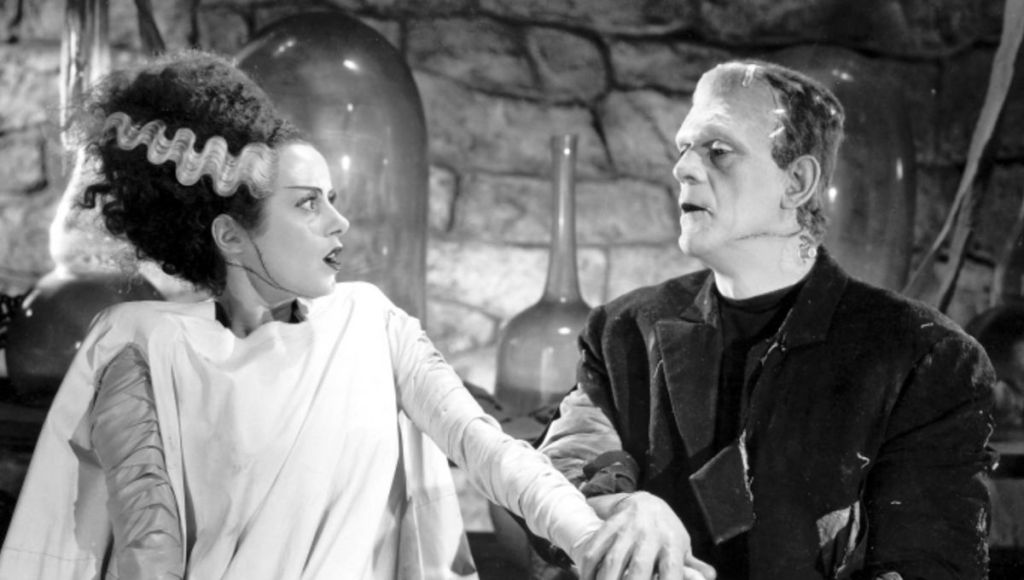
Yet, the idea of losing control over women has been a major theme of Hollywood for years, with director James Whale’s 1935 film Bride of Frankenstein standing as a shining example. The Bride only serves as a tool for both Doctor Pretorius (Ernest Thesiger) and Dr. Frankenstein (Colin Clive) to achieve what they want, all the while assuming Frankenstein’s Monster wants a woman. The only character who sees The Bride as a companion first and foremost rests with Frankenstein’s Monster. The collection of female parts to make The Bride correlate with the husbands from The Stepford Wives, as they cherry picked all of their best assets to create the ideal stay-at-home wife. It wasn’t about personality, character, or attitude; rather, it was about creating a model from the familiar, and as a result, stagnating technological development.
The first encounter of The Bride and Frankenstein’s monster certainly did not go as planned. (Image courtesy of Universal Pictures)
With Y2K encroaching in, terrified men felt a need to fight back and overcome the technology before it took over them. 1999 saw many films play with this concept, as white-collar office workers Peter (Ron Livingston), Samir (Ajay Naidu), and Michael Bolton (David Herman) go to town on Initech’s new copy machine to the tune of Geto Boys’ anthem, “Still,” in Mike Judge’s directorial feature, Office Space. Fight Club even features this “stick-it-to-tech” attitude, with Tyler Durden and his space monkeys of Project Mayhem aiming to destroy the credit card companies of the city by blowing them up with homemade explosives. These napalm goodies, as well as the whole concept of destroying companies holding credit card records, create Fight Club’s middle finger to consumerism, and ultimately the fate that was just around the corner. Just imagine The Narrator’s fascination with smart televisions and Alexa devices, only for Tyler to throw them out the window and evoke the wisdom of Nietzsche.
The bigger question to analyze today probably lies in discerning whether or not this kind of change-fearing male population still constitutes a wide array of the population. After all, many of the current industries, such as the tech industry, remain imbalanced with regards to gender. It goes without saying that both women and people of color have faced hardship and scorn from many white males throughout history. Jordan Peele challenges this concept in his 2017 directorial debut, Get Out. The ideas of loss of control and fear of power ripple throughout the film’s script, with elderly white folk seeking the keen eyes, strong builds, and creative spirits of many African American men. Peele clearly tips his hat to The Stepford Wives, yet calls upon racism and opposition to diversity instead of seeking female control. Get Out works so well and resonates with audiences so deeply for its connection to this current context. Aversion to African Americans and aversion to women both represent different fears, yet stem from the same hatred that’s permeated American culture. So while the Lester Burnham’s and Stepford Husbands of 20 years ago may be gone (in general), it seems that the fears that became realities for them have sent ripples into the white men of this current generation.
A frigid morning greets Jim Vitrano as he exits his tent at camp, which stands at an astounding 4,200 feet. Another adventurous, challenging day stands before him as he loads his cumbersome 45 pound backpack. Vitrano finds himself backpacking in the Catskills Mountains of New York. He and his fellow adventurers will be climbing even higher than their camp today, grasping at roots and trees to hoist themselves further and further. But for Vitrano and those journeying with him, this exists as a normal (yet challenging) endeavor. It’s not that he claims to be a mountain climber, or a persistent thrill-seeker. Rather, Vitrano is a member of the Boy Scouts of America, and this challenge stands as just one milestone he will carry with him forever.
History of an American Institution
The Boy Scouts of America got its start in 1908 on a small island off the southern coast of England. Robert Baden-Powell, a well-respected cavalry officer, took a group of 22 boys into the woods he had explored as a child. Baden-Powell imparted much of his wisdom and knowledge from the military onto the boys, teaching life skills and providing hands-on experience. According to Michael S. Rosenwald in an article for The Washington Post, Baden-Powell became “the Steve Jobs of the outdoors” to these young boys. Baden-Powell’s book “Aids to Scouting” became a phenomenon, and was essentially the bible for those interested in getting involved with the program.
The video shows the true nature, guidance, and dedication of Baden-Powell.
Brownsea Island, just off the coast of the United Kingdom, was the site where Baden-Powell’s tree of scouting truly began to bloom. On this island, the Wolves, Curlews, Ravens, and Bulls (four young patrols divided by Baden-Powell) woke up at 6 a.m. to milk and biscuits and day full of swimming, hiking, and enjoying the beauty of the indoors. From this one trip, Baden-Powell helped to establish the formation and ideals of the scouting experience, as troops began to form all over Britain.
William Boyce, a newspaper man from Illinois, eventually heard of the Boy Scouts when in London on business. Boyce soon met Baden-Powell, who explained his reasoning pertaining to the program. According to Alvin Townley, author of “Legacy of Honor: The Value and Influence of America’s Eagle Scouts,” Baden-Powell’s “ideas for building character in British youth captivated Boyce and set history in motion: scouting was coming to America.”
Brownsea Island exists as the location of scouting’s birth. (Image courtesy of Wikipedia)
Within America, the program flourished. Parents, officials, and administrators all recognized the importance of scouting in shaping America’s youth. No boy was to be excluded, regardless of race, religion, or background. As Benjamin René Jordan notes in his book “Modern Manhood and the Boy Scouts of America: Citizenship, Race, and the Environment, 1910-1930,” “the organization [BSA] drew widespread praise and government support for its plan to ease the growing tensions in America’s urbanizing, industrializing society by promulgating a universal model of manhood and participating citizenship.” The BSA provides young boys with a way to become model men and citizens of the future in a way that sports or other extracurricular activities cannot, all thanks to Baden-Powell and Boyce.
A Closer, More Modern Look
In the years since, scouting has seen immense international growth. What once saw Baden-Powell and young boys sharing milk and biscuits in the early morning around the campsite now finds endless lines of young men sprawled across an open field, hoisting the flags of their countries in the morning colors of the yearly World Jamboree. Boys no longer hike, swim, and fish together as they did with Baden-Powell, but rather go their separate ways to complete merit badges that are of specific interest to them. In the ensuing years, the program has been tailored to become a unique experience for each individual boy, with the connective tissue of strong networking and development of moral character always having been present.
One of the goals of the BSA has always been to provide young men with role models through troop leaders and other adult volunteers. These leaders are critical in helping the boys to shape their own leadership styles and develop the path of their own journey through the program. Troops establish a senior patrol leader (SPL) who acts as the youth leader of the troop. In doing this, the troop’s adult leader can provide guidance when necessary, but also see the true value of the BSA at work. This certainly stands as the case for Jim Vitrano, leader of Boy Scout Troop 88 in Millersville, Pennsylvania.
The video displays how a typical Boy Scout meeting currently runs.
As Vitrano sits back and watches his SPL lead the meeting from a distance, the clarity of what the BSA program should do stands clear. A wise man with scouting knowledge instilled in him since he was seven years old, he has a clear vision for what he wants to accomplish, and this vision comes across as his scouts answer scenarios regarding first aid care. “With Scouting, only 1 out of 100 boys will carry on and complete the program. We teach ideas, lessons, and morals that are not approached in school. The boys learn to rely and depend on themselves,” says Vitrano. The goal rings clear, as Vitrano envisions this as the boys’ troop, and not his. “Unlike sports, this troop has no star. It’s about the boys all relying on each other,” states Vitrano.
This hands-off, youth-led approach encompasses many of the tenets of the BSA. In this program, boys truly gather their own individualized experience, aided by the assistance of adult leaders and counselors. A troop dictated by an adult leader would miss out on this experience, as the adult would seek the best path for the troop, and not the boys themselves. This forces the boys to contact their own merit badge counselors, for instance, a skill that teaches time management and public speaking, among many other aspects. These adults, such as Vitrano, then form a strong network for the scouts, becoming figures they can rely on and go to throughout the rest of their lives.
Development of Character
Bryan Fencl, a young, blonde-haired Cub Scout, has learned a great deal in his few years of scouting about what it takes to create a fine young man. These teachings were put into place when Fencl, only nine years old, started a club to assist in ending the bullying of classmate David, who has autism. This club supplies David with a buddy wherever he goes to ensure that no one persists in bullying, an issue that even teachers struggled to keep in control. Fencl proves to be just one young man of many involved in Scouts who wears their character and heart on their sleeve.
A piece of hard candy and a thumbs-up were all it took for Matthew Dewey, another young Cub Scout, to save his friend’s life. Dewey noticed his friend appeared to be choking, and when he asked, his friend provided a thumbs-up. This signaled Dewey to perform the Heimlich maneuver, a procedure he had learned through scouting. His friend’s life was saved, and Dewey was nominated for the Medal of Merit, according to the “Bryan on Scouting” blog.
These two stories represent just two of the many which reinforce scouting’s goal of developing character in young men. While sports and academic clubs also develop character and discipline, scouting does so in a way that grounds itself more in the everyday life of ordinary people. The situation of Dewey saving his friend’s life could be a situation he could have performed anywhere someone found themselves in that serious predicament. These are the ideas that Glenn Arizini, Scoutmaster of Troop 72 in Overlook Hills, Pennsylvania, finds so appealing. “Scouting’s own core values teach respect for oneself and others which can only lead for one to make ethical decisions and to understand the importance they hold as a citizen of their community, nation, and world,” says Arizini.
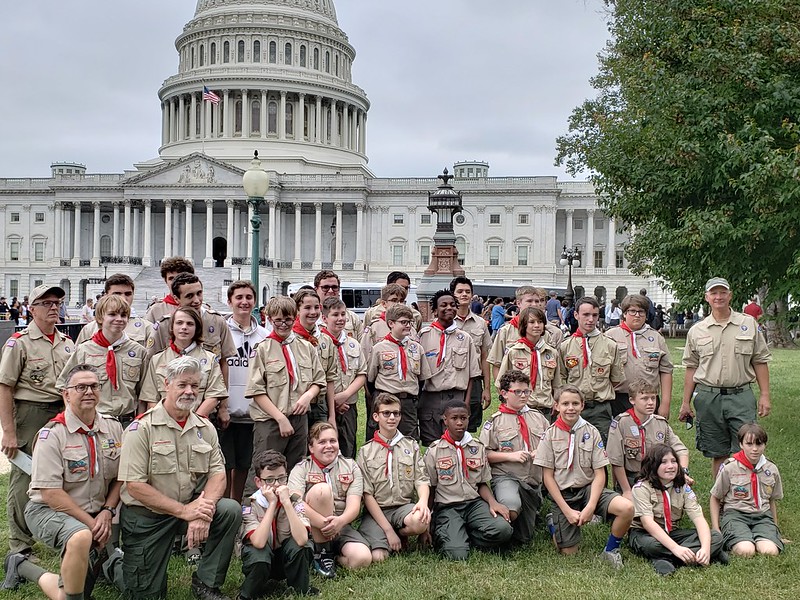
The scouts and leaders of Troop 72 of Overlook Hills, Pennsylvania pose outside the Capitol Building in Washington D.C., which they visited in October 2018. (Image courtesy of Troop 72)
Arizini, a husband and father of three, identifies as an individual who has not only seen these values play out through his own children’s experiences as Eagle Scouts, but also in the life of every scout in his troop. For Troop 72, the scouting experience doesn’t just involve tents, merit badges, and fishing, but rather volunteering to help others and foster personal growth. These ideas come into play every November with Troop 72 as they walk door-to-door in the dark of the early night, providing bags to donate canned goods and other foods to homeless shelters for Thanksgiving. In partaking in this event, the boys learn the value of giving back and spreading awareness of a project, a skill that will surely help them in the future with becoming Eagle Scouts.
Not Without Controversy
As strong of a program as the BSA has been, it certainly has not gone without any controversy. One of the most focal aspects of its controversy lies in the unfortunate sexual abuse cases ruled against the organization. With more than two million active Scouts and one million active volunteers, the severity of this issue cannot be overstated.
Stewart Eisenberg, a Philadelphia personal injury attorney, has represented around 800 men across the country who have had these negative experiences in the scouting program. All of these men report that they were sexually assaulted by scout leaders within the program. According to Eisenberg in an interview with NPR, “there is a crisis in the Boy Scouts, and there has been for many years, many decades – in fact, since the early 1900s.”
While these types of cases have been sending ripples throughout the BSA over the past few years, 2012 was particularly significant. The Oregon Supreme Court ruled that the “ineligible volunteer files” be released in that year. These files contain recognition of the pedophilia and other sexual assaults committed by scout leaders. Eisenberg also notes that many victims identify leaders who haven’t even been recognized by the files, an aspect that illustrates just how deep these misdeeds go.
Another major aspect of controversy regarding the BSA lies in the aspect of inclusion. In 2017, the BSA announced that it would open the program to young girls, chiefly to allow them the opportunity to become Eagle Scouts. Early 2019 saw this goal realized, and the program became known as “Scouts BSA” to foster inclusion and eliminate any gender barriers. Many were excited at this new prospect, yet not everyone was totally prepared.
The Girl Scouts of USA (GSUSA) greatly criticized this movement, making their thoughts and opinions known to various outlets. GSUSA proclaimed that the “benefit of the single-gender environment has been well-documented by educators, scholars, and other girl-and-youth serving organizations, and Girl Scouts and their families.” A lawsuit was even filed by GSUSA over the BSA becoming “Scouts USA.” Even though both programs have roots firmly planted in developing a nurturing and educationally rich experience for youth, they have been separate entities for years. Thus, many also criticized this move on the part of the BSA as being charged by a drive to be politically correct.
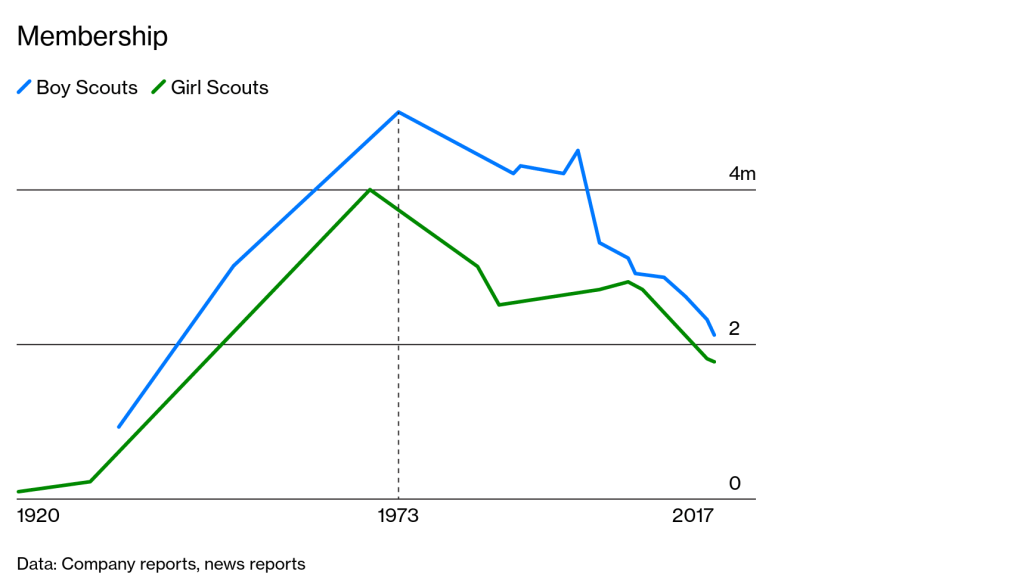
The line graph above represents the numbers of membership to the BSA and GSUSA. (Graph courtesy of Bloomberg BusinessWeek)
Even through this unfortunate controversy, the BSA has always stood strong and remained firmly in service to providing young men (and women, currently) with a thrilling and full experience. These situations have certainly rocked the organization unsteadily, but it will always remain an American institution with eyes towards the future. Many are optimistic about its changes in an ever-expanding world, and are eager to see the core values adapt to new environments.
The Future of Scouting
At one time, merit badges in fishing and hiking were extremely popular. And even though these merit badges still exist, new ones have been added dealing with engineering, technology, and video games, all fields that hold avid interest within the youth today. As these badges are geared towards guiding scouts on a career path, the urgency to include those stands as a priority for the BSA. Over the years, the program has had to adapt to the ever-changing societal landscape and various burgeoning technologies. The process will likely never be fully completed, but it looks to be an area that many involved with scouting are eager to keep an eye on.
According to the BSA National Foundation, the goal of the BSA’s future looks to “draw from our [BSA’s] rich history to respond to the needs of today’s youth.” The merit badge additions stand as just one small example of this adaptation. For instance, many troops maintain active websites and social media pages, allowing prospective scouts and their parents to have a general idea of what to expect before joining or going to a meeting. These new ideas regarding new technologies and fields have even permeated the landscape of Eagle Scout projects, an area long thought by many to be relegated to outdoor projects.
Joshua Jaslow, an intelligent and active scout with interests in music and rock climbing, became an Eagle Scout with Troop 72 in 2016. His project consisted of restoring the website of the Bryn Athyn Fire Company, in addition to including the rich history of the organization within the website. Ten years ago, this project would have been unheard of. But these new advances in technology, coupled with the greater understanding and allowances which the BSA provides, allowed Jaslow to craft and complete this project. As untraditional as it may have seemed to some many years ago, these projects, or ones rooted in STEM, are the new normal.
Jaslow became Troop 72’s 201st Eagle Scout when he earned the rank in 2016. (Image courtesy of Troop 72)
Even with the presentation of many of its challenges and shortcomings, many remain optimistic about Scouting’s future and what it will hold. “Scouting, like all organizations, will continue to face challenges; however, as long as they are presented, addressed, and acted upon, scouting will continue to be a great program to be a member of,” states Arizini. The core idea of these changes, as noted by the BSA National Foundation, looks to root these changes in the values and ideals of Scouting, such as “being prepared” and “doing a good turn daily.” Many have seen these changes as helping them towards their future, regardless of whether they attained the rank of Eagle Scout or not. Scouts moving on to college, joining the military, or partaking in a trade job have all found the experience of this program to be extremely vital to their futures.
Matthew Wilson, an Eagle Scout of Troop 72 who enlisted in the Marine Academy, always carries the values of the BSA with him. “I learned that you never really can do anything alone. It sounds kind of silly, but teamwork really does make the dream work – I learned that through my own Eagle Scout project, and I even saw it when I was in the Academy,” states Wilson. Moving from troop to troop can be a difficult transition, and it was one challenge that Wilson faced in his scouting experience. Yet, the values of the program always stayed with him, and he persisted within the program. He was welcomed into his new troop, where the new challenges became all the more obvious. But through all of this difficulty, Wilson never considered leaving the program. “I just couldn’t lose out on the experience, it’s too valuable. Being a Boy Scout will always be a part of my identity,” said Wilson.
About the Author
John Lutz is a senior at Millersville University majoring in Digital Journalism and minoring in Film Studies. He is a regular weekly disc jockey for WIXQ, Millersville’s campus radio station. John has also written many stories about film and other topics for his own blog or on other blogs as an extension of podcasts. Upon graduating in spring 2020, John hopes to gain an internship in the Philadelphia area writing for either a print or digital publication.
The summer is great time to nuzzle up with a good book on the beach. With the sun shining down, cool water, and laughter all around it can be hard to imagine a better time of year. Summer also remains a great time for film – “Jurassic Park,” “Independence Day,” and “Spider-Man” are just a few examples of summer blockbuster films. 2019 is no exception, as films of various genres will hit theaters. Without further ado, here are my top nine films to watch out for this summer.
“Avengers: Endgame”
Summer begins a little early for theaters, as Marvel Studios decided to release their epic finale “Avengers: Endgame” in the last weekend of April. This week head start proved extremely successful for the studio, as the film has already crossed $2 billion globally. Critics have praised this film for its smart storytelling and emotional beats, so expect it to remain prominent in theaters as the summer rages on. In my own opinion, this film certainly lived up to the hype and is one I plan to catch in theaters again.
2. “Booksmart”
This directorial debut from actress Olivia Wilde tells the story of two high school senior girls who spent their high school career hitting the books and avoiding fun. Yet once they get into college, they decide to party and take back all of the good times they sacrificed. This film received some very positive reception when it premiered at the South by Southwest (SXSW) festival in March, and it definitely has a tone reminiscent of recent popular comedies (i.e. “21 Jump Street”). In my opinion, this film looks like a lot of fun and I think it could be a big crowd pleaser.
3. “Godzilla: King of the Monsters”
It’s been five years since we last saw the humongous lizard strut across the silver screen. He finally makes his return debut to theaters at the end of May, and if the trailers have been any indication, this film will certainly be epic. Director Michael Dougherty has also assembled a stellar supporting cast, a nice touch for a film where the focus will be on gigantic monsters. I personally find these monster/disaster movies to be one of my guilty pleasures. Strong scripts and storytelling aren’t usually the strong suits of these kinds of films, but as long as I get some great action and set pieces, I (and lots of audience members) should be pretty satisfied.
4. “Late Night”
Actress Mindy Kaling has been making a name for herself ever since her television turns on NBC’s “The Office” and Fox/Hulu’s “The Mindy Project.” This summer will see her take a major turn towards the silver screen, writing and acting in this comedy detailing the writing staff of a late night talk show. Starring opposite Emma Thompson is no small feat, yet I believe Kaling will really come into her own through this movie. I definitely can see this movie being a big hit, much akin to “The Big Sick” in 2017.
5. “Toy Story 4”
It’s been nine years since we’ve last seen Woody and the gang in what we thought to be the conclusion to a beautiful trilogy. Yet it seems Pixar has thought otherwise. I have a lot of faith in the cast and team behind the project, but this film will really need to prove to me (and lots of audience members) why we need another adventure with these toys. As for its financial prospects, I think the folks at Disney can rest easy as this will be a surefire hit.
6. “Spider-Man: Far from Home”
Tom Holland has proven to be an extremely popular Spider-Man, and after Marvel’s great (and continuing) success with “Avengers: Endgame,” audiences are likely eager to see his next adventure. A global field trip is something that no other film about Peter Parker has shown us. Add in the new villain of Jake Gyllenhaal’s Mysterio, and this film will definitely resonate with audiences when it hits theaters in July. In my opinion, Holland is a great Spider-Man, and I’m very much anticipating his character’s next adventure.
7. “The Lion King”
Disney has been making big strides lately to transition their successful animated films into live action versions. It proved very successful in 2016 for “The Jungle Book,” and I expect even more success with July’s “The Lion King.” The marketing appears to be sticking pretty close to the original, a smart choice for what many find to be their favorite Disney movie. I have a lot of faith in this film, as the same director of “The Jungle Book,” Jon Favreau, is also helming this movie.
8. “Once Upon a Time in… Hollywood”
It’s been four years since a film from acclaimed director Quentin Tarantino has hit theaters. This July, he returns to form with “Once Upon a Time in… Hollywood,” starring Brad Pitt and Leonardo DiCaprio. The film is expected to touch on the Manson murders, as well as the overall atmosphere of Hollywood at this time. I expect this one to be a big hit with avid film fans, and the setting and subject matter truly lend themselves to Tarantino’s brilliant style of dialogue.
9. “Hobbs and Shaw”
If the latest “Fast and Furious”
movies haven’t been crazy enough, this August will see the release of “Hobbs
and Shaw,” a spinoff film starring Dwayne Johnson and Jason Statham. Both
characters are fan favorites of the franchise, and I expect this movie to be
even more bonkers than the last. This movie looks like an off-the-wall,
action-filled adventure, and one that will certainly rule the box office in
August.
Nostalgia plays a huge role in the current culture
today. Stores such as Target and Cracker Barrel even have whole sections of
their stores dedicated to Rubik’s Cubes, “I Love Lucy,” and “Transformers.” One
program that also has prominence and nostalgia for many would be “The Twilight
Zone.”
Created in 1959 by Rod
Serling, the program sought to transport viewers into the extra dimension,
known coincidentally as the Twilight Zone. It clearly holds a place in the
hearts of many, as it is still popularly discussed today and even has an
insanely popular attraction at Walt Disney World in Orlando, Florida with the Tower
of Terror.
Furthermore, like many
popular elements of nostalgia, the show has been rebooted for CBS’s streaming
service, CBS All Access. The first few episodes have been released, but does it
hold up to the beloved standard of the original?
The first episode
available to streamers is titled “The Comedian.” It is directed by Owen Harris
and stars actor Kumail
Nanjiani. Nanjiani portrays struggling comedian Samir Wassan. After
a particularly difficult set, he makes a deal with a shady comedian, played by
Tracy Morgan. This comedian advises Samir to make his acts personal, which he
begins to do. From here, strange occurrences began to befall Samir and those
around him.
As a whole, the episode
served as a good introduction to those not familiar with “The Twilight Zone.” The
premise of the episode was basic enough to not lose any first-time viewers. The
story also set up the characters and world of “The Twilight Zone” well, an
aspect that is sure to benefit episodes to come.
The performances in this
episode are also top notch. Nanjiani, known primarily for comedies like “The
Big Sick,” absolutely nails this dramatic turn. While some dramatic beats came
through in his past works, this performance showed true skill as he needed to
react to all of the turmoil around him. Tracy Morgan also offers a bizarre take
as this idolized comedian. It’s honestly nothing he has ever done before, and
he does a good job with his limited screen time.
While this episode primarily
worked for me, I’d be lying if I said it was flawless. While the story serves
the characters well, it’s rather predictable. I was pretty much able to foresee
just about everything that would happen, up to and including the end. This can
be a bummer, especially for a show that lives on suspense, as this one does.
Overall, I thoroughly enjoyed
this first offering of “The Twilight Zone” reboot and can’t wait to dig into
the upcoming episodes.
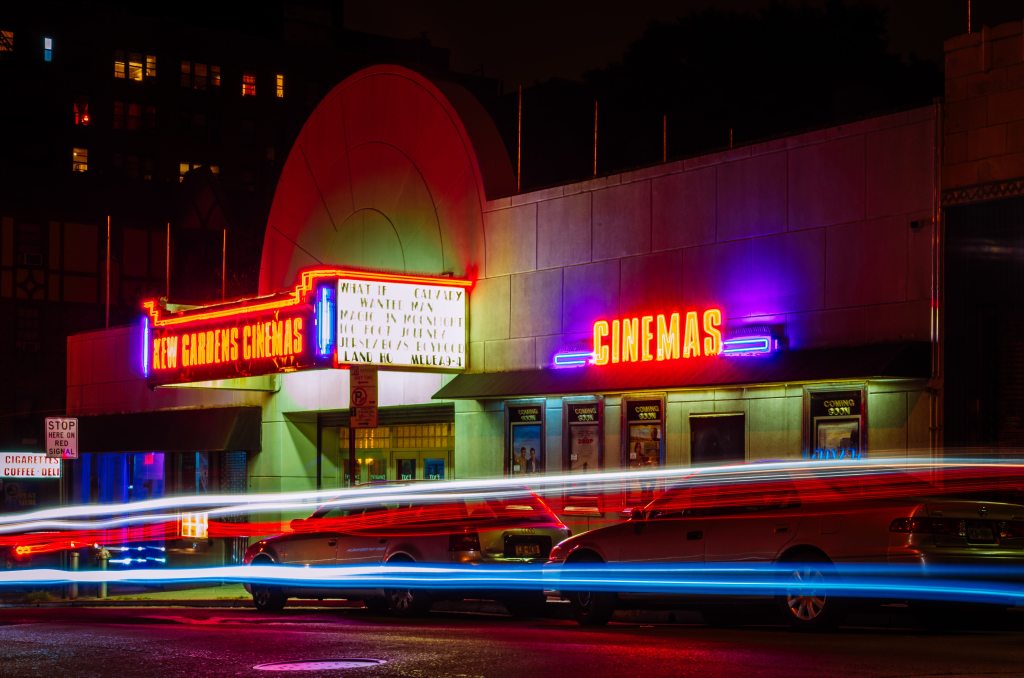
Photo by Monica Silvestre from PexelsPhoto obtained from Pexels
As I approach the theater
roughly thirty minutes early to ensure a good seat, I see the line backed up
far past the door. It’s no doubt a Friday night, and a major studio has
released one of their major blockbuster films. But this line is like no other.
The one for tickets extends far into the parking lot, and those outside the
theater block the vending machines and restrooms. For an avid film fan, it’s
clear that these lines are the result of a Marvel film being released. These
are the kinds of experiences I have had since becoming a follower of the Marvel
Cinematic Universe since The Avengers’
release in May 2012. Seven years later and thirteen films deeper, and Marvel
has put forth their first female-led solo film in Captain Marvel. In all, I had lots of fun with this movie and
thoroughly enjoyed the performances and atmosphere.
This
film tells the story of Carol Danvers, a former Air Force pilot who is unable
to remember her past. She finds herself as a member of the Kree Star Force, an
elite space team much akin to the Special Ops teams of the present. She soon
finds herself stranded on Earth, where she runs into S.H.I.E.L.D. agent Nick
Fury, who helps to uncover her past and overcome the obstacles of her history.
For
those just getting into the Marvel Cinematic Universe, this film can certainly
be enjoyed without much awareness of what has come before it. There are tons of
Easter eggs (hints and clues only hardcore fans will recognize), but also tons
of jokes and explanations to relate to the first-time Marvel viewer.
To
begin with my thoughts, there’s certainly a lot to enjoy about this film. The
above synopsis definitely sounds intimidating for those not familiar with the
comics, but directors Anna Boden and Ryan Fleck do an excellent job of making
this a film for both the average fan and the diehard Marvel Cinematic Universe
fanatics. The major highlight of the film for me were the performances. Brie
Larson brings such humanity and realism to the character of Danvers. She is
completely believable as both a confident and snarky pilot, but also as a
troubled woman who has lost touch with her past. Samuel L. Jackson does a great
job reprising his role as Nick Fury, and his chemistry with Larson truly is off
the charts. Ben Mendelsohn is also a major standout as Talos, leader of the
shapeshifting alien race known as the Skrulls.
The
film’s soundtrack and atmosphere are also a major plus. The film takes place
around 1995, and Marvel does a great job depicting the time period. I truly was
immersed in the nostalgia for this decade, from everything to Danvers crashing
into a Blockbuster video store to an action set piece fought to the tune of No
Doubt’s “Just a Girl.”
Lastly, one of this
film’s biggest strengths is that it knows what it is. While some Marvel films,
like Captain America: The Winter Soldier and
Avengers: Infinity War have much
higher stakes, this film serves extremely well as a fun sci-fi adventure where
fans can relax and not have to sit on the edge of their seats.
While
I did have lots of fun with this film, it would be a stretch to call it a
perfect movie. As a whole, it is pretty forgettable. Marvel films like Thor Ragnarok and Captain America: Civil War have clearly established tones that
firmly cement the films in a certain genre, but overall a piece of the same
cinematic universe. While Captain Marvel
has a fun, 90’s action vibe, it lacks the same significant stamp that most
other Marvel movies have.
The
movie also definitely leaves some characters on the sidelines. Some notable
mentions include Jude Law, playing the role of Carol’s mentor, as well as the
rest of the Starforce team. While Marvel isn’t known too well for their side
characters, some of their films have proven to balance the whole ensemble quite
well – just look to last year’s critical and financial darling Black Panther.
To
finish with my thoughts, this film definitely lands around the middle within
the Marvel Cinematic Universe. Some of my favorite films in the series include Iron Man, Guardians of the Galaxy, and my absolute favorite Captain America: Civil War. All of these
films are tons of fun and carry real, tangible stakes. I don’t know that I
would say Captain Marvel lacked
stakes, but it just didn’t carry the same weight that the other films had. On
one hand, that’s totally fine. Not every film will be as important or as heavy
as the last. But at the same time, in making a shared universe, it would be best
if every film packed the same level of punch (in some way) as the last.
Overall, directors Boden and Fleck
crafted an enjoyable movie that works best as a fun, sci-fi action film. Some
tonal and character issues aside, this is certainly a movie I would have no
problem watching again. With all of that being said, these are only my
opinions. All film is subjective, and plenty of other
reviewers may have felt differently.
�E�
While the Oscars on Sunday evening were full of
heartfelt moments and crowd-pleasing wins, not all left Hollywood’s Dolby
Theatre with a smile.
Even
though he was fresh off his first Oscar win for adapting the screenplay for his
film BlackKklansman, Spike Lee was
outraged when Julia Roberts announced the controversial Green Book as the Best Picture of 2018. He was about to storm out
of the theater when Jordan Peele, a producer on BlackKklansman, stopped Lee from walking out the doors. Instead,
Lee decided to protest by pitting his back to the stage as the Green Book team gave their acceptance
speech.
Green Book certainly did not move
throughout awards season without its share of difficulty. There was the
incident of star Viggo Mortensen employing a racial slur during a press
interview, as well as the family of Don Shirley (portrayed by two-time Academy
Award winner Mahershala Ali), not being happy with the overall film. Yet, it
has always been viewed as a favorite for the prestigious final award, and Lee’s
BlackKklansman was never highly
predicted to win out over it. To read even more about Green Book’s controversy, click here.
Though
this event is certainly sour, there is some humor to be had with it. At the Academy
Awards honoring the movies of 1989, the film Driving Miss Daisy won the top prize. That film, starring Morgan
Freeman and Jessica Tandy, has many parallels to Green Book. Lee certainly made this and his bitter attitude obvious
in subsequent press interviews. When asked what he thought about Green Book’s win, he stated “every time
someone’s driving somebody, we lose – they just changed the seating arrangement
this time.”
—
In my
opinion, Green Book deserved to win
Best Picture. It was one of my favorite films of 2018, and was an impressive
dramatic debut for director Peter Farrelly. I certainly can see the argument
for Green Book being a safe choice. I
also can see that the film’s message can be seen as rather simplistic. But, I
believe that this was the kind of movie America needed in today’s day and age.
Lee tackles similar racial issues in BlackKklansman,
but that film’s tone is a gut punch compared to Green Book’s light tap. Green
Book also exists to serve as a “feel-good” movie – one that audiences can
walk away from with their heads held high. With the current politic climate, I
believe that we deserve a movie that can make us feel good about ourselves and
our country. It’s just a shame that we can’t all feel that way.
Hello! My name is John Lutz, and I am the author of
this film and television review blog. Here, you can find all types of reviews,
news, and content regarding the world of film and television. I am an avid
follower of these two mediums, and stay up to date on the latest trends and
news pertaining to both. I am also a lover of writing and reading, as can be
evidenced by my current major at Millersville University of Digital Journalism.
I’ve
pretty much been in love with both film and television since the age of eleven.
Movies such as Jurassic Park, The Avengers, and the Shawshank Redemption I credit with my
love of storytelling in both the film and series format. I find films and
television to be very transporting, and I love watching whatever I can,
whenever I can. In the current age of streaming, more and more content gets
added each and every day to services such as Netflix, Hulu, and HBO. This,
coupled with new releases in theaters each weekend, can make for a daunting
task in terms of posting news and opinions. Yet, I will strive to provide
persistent content that can keep readers informed and knowledgeable about the
worlds of film and television.
Here
are two links that I use daily to stay up-to-date on the latest about film and
television.











 John's Blog